How Interest Rates Affect Your Mortgage
Published on July 28, 2026 | 9 Minute read

Patrick
Kilduff
Data Scientist
Buying a home right now means dealing with two problems at once. Prices are up, and so is the cost of borrowing. Rates dipped near 3% earlier this decade; today they're sitting above 6%, and median home prices have climbed roughly 50% over the same stretch. For a lot of buyers, the affordability math they grew up hearing about simply doesn't apply anymore.
Which is exactly why it's worth slowing down and understanding how mortgage interest actually gets repaid, because your rate does more than set your payment. It decides how fast you build equity, and that pace ends up shaping bigger decisions later, like when refinancing makes sense or whether selling in year five would even leave you ahead.
What Is a Mortgage Interest Rate?
A mortgage is a loan used to finance a home purchase. The lender pays the seller upfront, and you repay the lender over time with interest. The interest rate is the annual percentage charged on whatever you still owe.
Rates have covered a lot of ground over the years. Since the early 1970s, the 30-year mortgage has averaged above 7%. They hit record lows of 2.65% during the pandemic. In the early 1980s they soared past 18% (really)! Lately, rates have held in the 6% to 6.5% range.
How Interest Rates Affect Your Monthly Payment and Total Cost
Your monthly payment is the number everyone fixates on, and fair enough, it's the one that hits your bank account. But the rate is also quietly deciding how much of each payment actually reduces what you owe. The most common duration for mortgages are 15 and 30 years. A 30-year mortgage is 360 payments. A 15-year is 180. How those payments split between principal and interest depends mostly on your rate, though the loan's length and type matter, too. Shorter terms mean less total interest. A fixed rate stays put; an adjustable one can move both up and down on you.
Here's the part you don't control: the baseline. You can nudge your own rate down with better credit or a bigger down payment, but the going rate for mortgages is set by the economy. When things slow down, rates tend to fall to get people borrowing again. When growth runs hot and inflation climbs, rates go up to cool it off. And the higher that baseline sits, the more the loan costs you in total, the more you pay each month, and the longer it takes for your payments to start making a real dent in the principal.
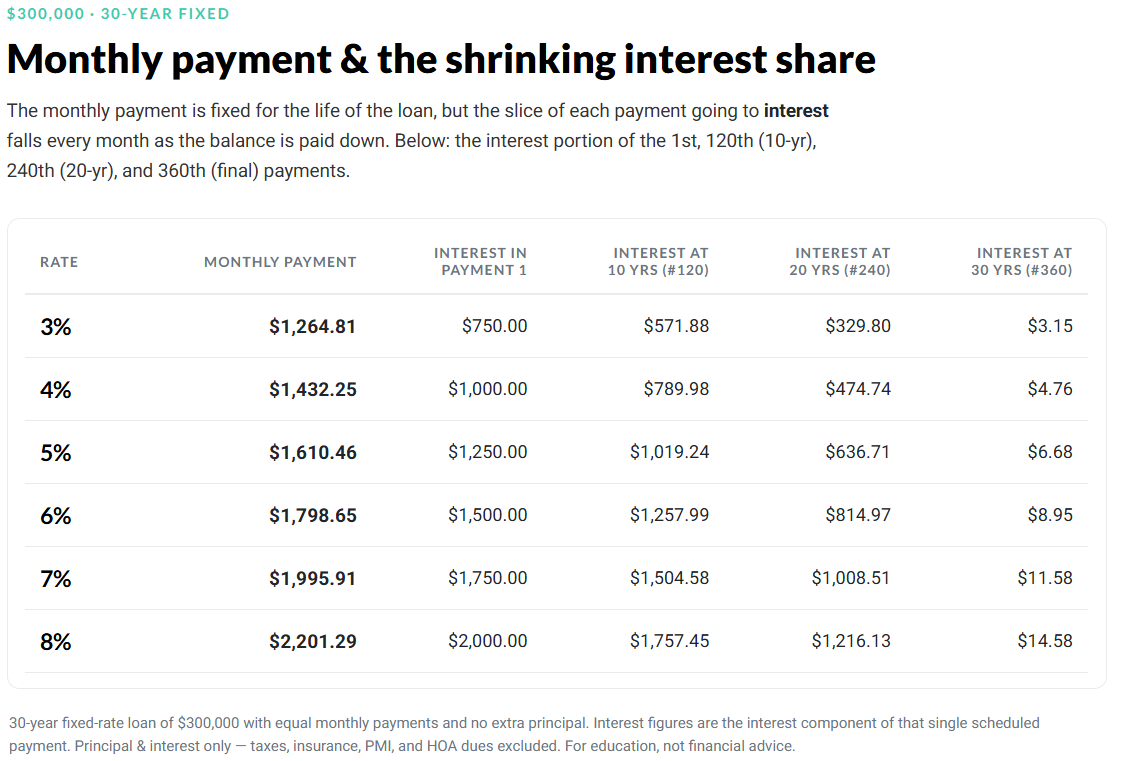
The math itself is standardized. Give a lender a rate and a term and the amortization formula spits out your payment and total cost. The examples below all use the same loan so the comparisons are apples to apples: 30-year fixed, $300,000.
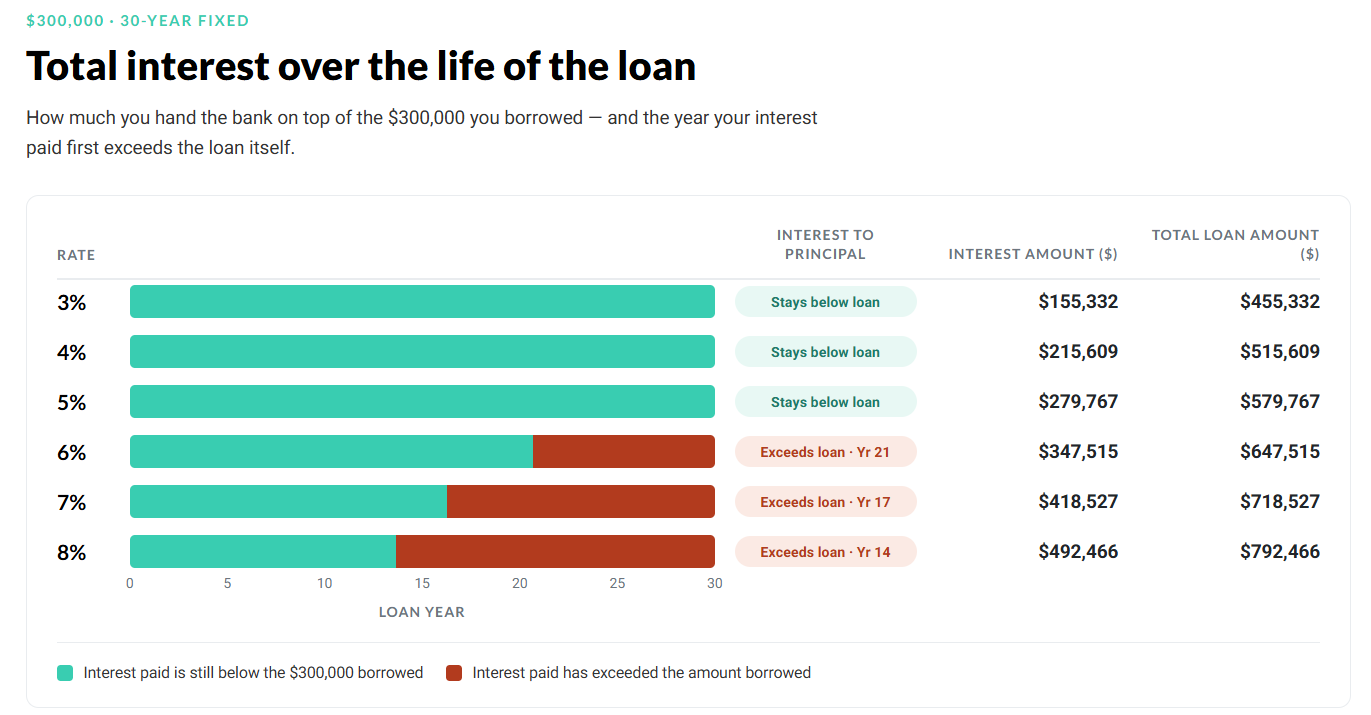
At 3%, the payment is $1,265 a month, and you'd pay $155,332 in interest over the life of the loan. Total cost: $455,332. Run the same loan at 6% and the payment becomes $1,799, but look at the interest: $347,515, for a total of $647,515. Same house. Same amount borrowed. More than double the interest.
Quick note on scope before going further. Everything here covers principal and interest only. Your real monthly payment will also include property taxes, homeowners insurance, and HOA fees where they apply.
Will You Pay More in Interest Than You Borrowed?
There's a threshold most buyers have never thought about: the rate at which your total interest equals the amount you borrowed. On a 30-year fixed loan it sits around 5.3%. Anything above that, and you'll eventually hand the bank more in interest than they ever lent you.
How soon depends on the rate. At 6%, your cumulative interest passes the original loan amount in year 21. At 7% it happens by year 17, and at 8% you get there in year 14.
If those numbers sting, some perspective helps. Borrowers in the early 1980s were signing mortgages at 15% and up, paying more than 3.5 times the loan amount in interest, and crossing that same threshold in under 7 years. Ouch.
Why Do Early Mortgage Payments Mostly Go to Interest?
This is the one that catches new homeowners off guard. You make your first payment, look at the breakdown, and almost none of it touched the principal. A reasonable person would assume the split stays even over time. It doesn't, and the reason is the amortization schedule.
Each month's interest is calculated on your outstanding balance. That balance is at its peak on day one, so your earliest payments are mostly interest by design, not by trickery. As the balance shrinks, the interest charge shrinks with it, and more of your fixed payment gets through to the principal.
Your rate decides how lopsided things start. At 3%, nearly 60% of the first payment goes to interest, $750.00 of the $1,264.81. At 6% it's worse: over 83%, or $1,500.00 of $1,798.60.
When Principal Overtakes Interest
Eventually the split flips, and more of your payment goes to principal than interest. It's a milestone worth knowing about, because it marks where equity starts building in earnest. At 3%, the crossover comes in year 8 of our example loan. At 6% you wait until year 19. Same loan, more than a decade of difference. And since equity is what you walk away with when you sell, minus the costs of the sale, how fast you build it has a lot to say about when selling would actually leave you ahead.
Why Shopping Around for Mortgage Rates Matters
An interest rate is just the price of borrowed money, and lenders price it on risk. Steady income, a solid work history, and strong credit tell a lender you're unlikely to default, so they charge you less for the loan. A patchy job record or weak credit reads as risk, and the rate goes up to cover it.
What that means in practice: quotes are worth comparing even when they look nearly identical. A fraction of a percent doesn't sound like much on paper. Over 360 payments it's tens of thousands of dollars, and the gap gets uglier as rates climb. You can see it in Table 2 on the $300,000 loan. Going from 3% to 4% adds about $60,278 in interest. Going from 7% to 8% adds $73,937.
Typical Mortgage Loan Types
Fixed-Rate Loans
With a fixed-rate mortgage, the rate you close at is the rate you keep. Your principal-plus-interest payment never moves, which makes budgeting simpler and removes the market from your monthly life entirely. The catch is that fixed rates usually start higher than an ARM's introductory rate. That's the price of certainty. Closing at a high rate isn't a life sentence, because you can refinance later if rates fall far enough to justify the cost.
Adjustable-Rate Mortgages (ARMs)
An ARM starts with a fixed introductory rate, usually for 5, 7, or 10 years, and then adjusts every 6 or 12 months with the market. The appeal is obvious: that intro rate typically beats anything a fixed loan offers. The risk is everything after it. If rates climb, your payment climbs, and so does the total cost of the loan. ARMs do have caps limiting how far the rate can jump at the first adjustment, at each one after, and over the loan's lifetime. But a cap is a ceiling, not a promise you'll be comfortable under it.
Factors Influencing Interest Rates
Four things do most of the work in setting your rate. Only one of them is out of your hands.
Economic Conditions
Rates follow the economy: up in expansions, down in slowdowns, when cheaper borrowing is used to get money moving again.
Your Credit Score
Higher score, lower perceived risk, better rate. It's the most direct lever you have.
Loan Term
Shorter terms usually get lower rates but cost more per month. Longer terms trade the other way.
Down Payment
More money down means less risk for the lender, and lenders pay for less risk with better rates.
How Rates Affect What You Can Afford
A single percentage point moves your payment more than people expect. On a $300,000 loan, 1% is hundreds of dollars a month, which is how buyers who qualified comfortably at one rate end up stretched thin after a jump.
Rates also set your buying power before you ever tour a home. Low rates qualify you for a bigger loan and open up more of the market. When rates rise, the same monthly budget simply buys less house. Knowing where that line sits for you is worth doing before you fall in love with anything.
How to Get a Better Mortgage Rate
Improve Your Credit Before You Apply
Pay down debts, keep bills current, and dispute any errors sitting on your credit report. Even a modest bump in your score can move your rate.
Shop Multiple Lenders
Get quotes from at least three lenders and put the rates, fees, and terms side by side. The Table 2 numbers are the argument here: a fraction of a percent is real money over 30 years.
Consider the Loan Term
A shorter term buys you a lower rate at the cost of a higher payment. Pick the tradeoff your actual monthly budget can carry, not the one that looks best on paper.
Put More Down
A bigger down payment shrinks the lender's risk, and that often comes back to you as a better rate and lower total borrowing costs.
Lock Your Rate
Rates move daily. Once you've got a quote you like, a rate lock holds it for a set window while you close, so a bad week in the market doesn't cost you. Locking a good rate is one piece of the bigger picture of what you can actually afford to borrow.
Before you apply, it's also worth reviewing the most common mistakes buyers make when shopping for a mortgage.
Rates Shape the Whole Journey, Not Just the Payment
Your rate is with you for the life of the loan. It sets the payment, it decides how fast the home becomes yours in any meaningful sense, and it quietly influences when refinancing or selling starts to make sense. You can't control where the market puts rates. You can control your credit, your down payment, how many lenders you make compete for you, and which loan structure you sign. Across 360 payments, those choices compound. An agent who knows your market can help you put these numbers in context, and finding one through PrimeStreet takes one call.
Disclaimer: This article is intended for general informational purposes only and does not constitute legal, financial, or real estate advice. Always consult a licensed professional before making decisions based on this information.